As the autumn colors begin their march along the North Shore and the air turns crisp over the Iron Range, homeowners know what’s coming next. Autumn in Northern Minnesota is stunning, but it serves as a brief warning period before sub-zero temperatures arrive.
For homeowners with automated irrigation systems, autumn is the most critical window of the year. Your sprinkler system represents a significant investment in your home’s curb appeal and health. Leaving water trapped inside those lines when the Minnesota frost sets in can cause thousands of dollars in hidden damage beneath your lawn.
While tackling home maintenance projects yourself is a point of pride for many Minnesotans, winterizing an irrigation system is one job where a DIY approach often leads to costly spring surprises. This guide covers the mechanics of sprinkler winterization, why household air compressors fail in our extreme climate, the ideal booking timeline for the Duluth and Iron Range region, and what a true professional blowout entails.
The Harsh Reality of Northern Minnesota Winters
To understand why irrigation winterization is so vital, you have to look below the surface. Northern Minnesota experiences some of the deepest frost lines in the entire United States. In the Duluth area and across the Iron Range, frost routinely penetrates 40 to 60 inches—and sometimes deeper—into the soil during severe winters.
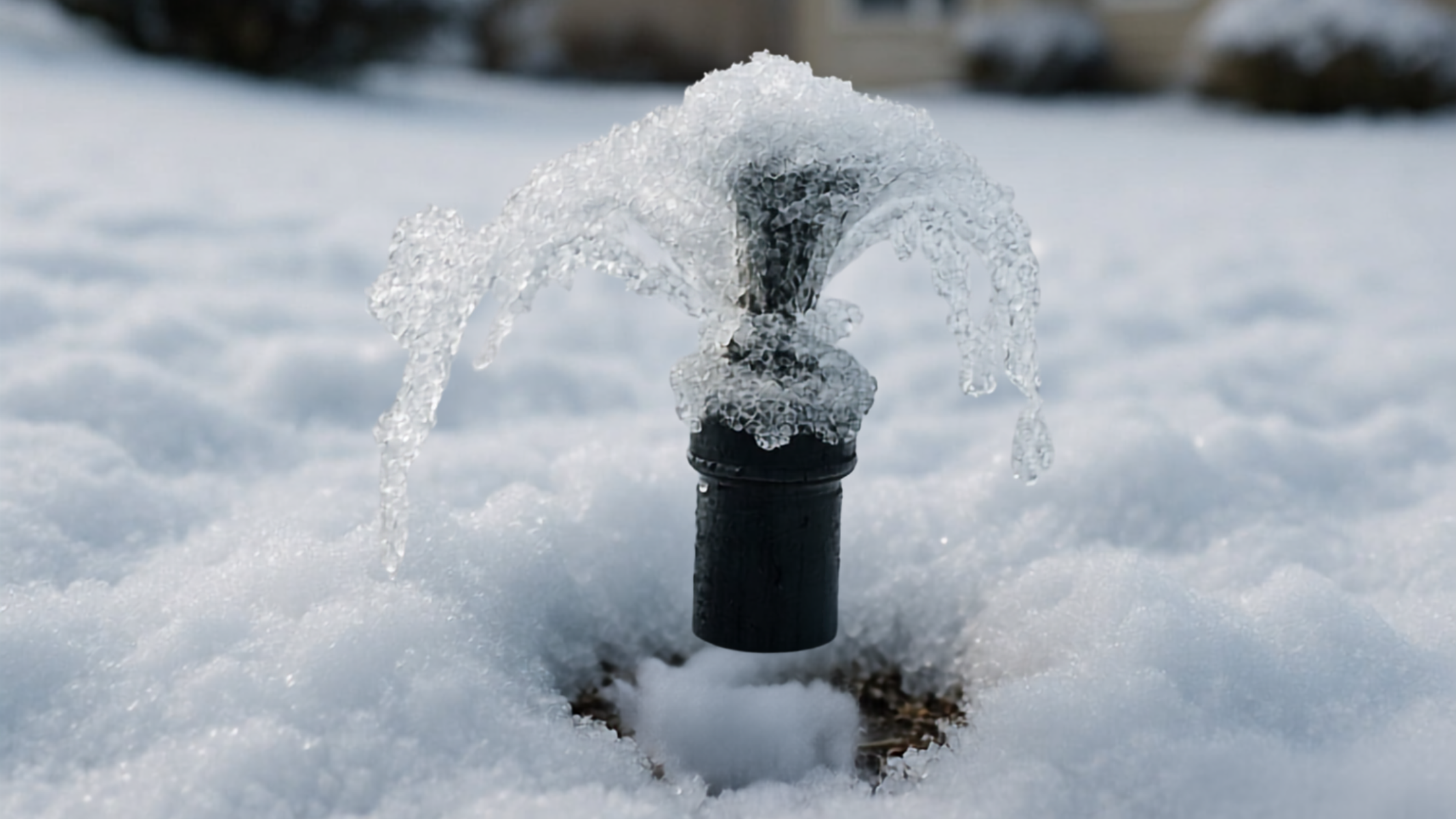
When water freezes, it expands by roughly 9%. If water remains trapped inside rigid PVC manifolds, flexible polyethylene pipes, solenoid valves, or brass backflow preventers, that expansion generates immense hydraulic pressure. The trapped ice does not simply expand into empty space; it exerts forces exceeding thousands of pounds per square inch against the walls of your irrigation components.
The results are catastrophic:
- Shattered Backflow Assemblies: The brass valves located above ground or just below grade freeze first, often cracking the heavy brass housing beyond repair.
- Split Polyethylene Tubing: Underground pipes crack lengthwise under soil pressure combined with internal ice expansion.
- Blown Valve Manifolds: Solenoid valves crack, damaging internal diaphragms and threading.
- Popped Sprinkler Heads: Water trapped inside the riser mechanism freezes, pushing the internal seals out or snapping the plastic casing.
Because irrigation lines are buried only 10 to 18 inches deep, they sit squarely within the absolute freeze zone. They do not benefit from the heat buffer of deeper utility lines. Every drop of residual water in your system will freeze solid between November and April.
Why DIY Sprinkler Blowouts Fail in the Duluth & Iron Range Cold
It is a common sight in early autumn: a homeowner dragging a 6-gallon or 20-gallon garage air compressor out to the yard, attaching a quick-connect hose adapter to their irrigation blow-out port, and attempting to clear the lines themselves.
While the DIY spirit is admirable, household air compressors lack the specific physics required to safely clear an underground sprinkler network in a northern climate.
The Physics: CFM vs. PSI
The main reason DIY blowouts fail comes down to two air measurements: PSI (Pounds per Square Inch) and CFM(Cubic Feet per Minute).
Low Volume Creates "Water Trickling"
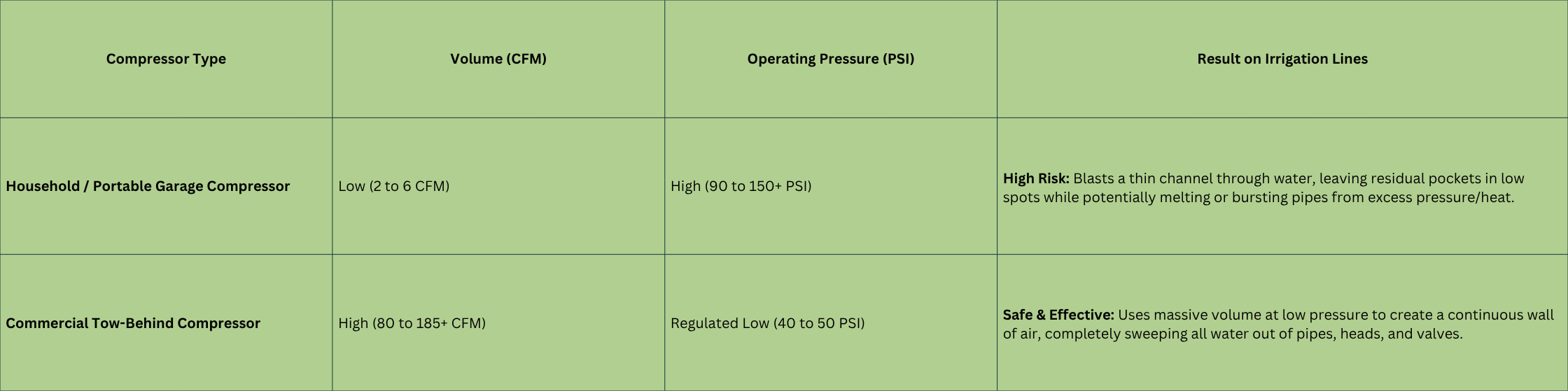
A household compressor produces high pressure (PSI) but very low air volume (CFM). When connected to a 1-inch underground irrigation line, a small compressor shoots a fast, narrow jet of air through the top of the pipe. It blows out the water immediately in front of the connection point, but as the air travels, it simply rides over the water settled in low points along the line.
This creates a false sense of security. You see a mist shoot out of the sprinkler head and assume the zone is dry. In reality, standing water remains trapped in low spots, underground dips, and solenoid valve bodies. When the deep frost hits in December, those low-point water pockets freeze and split the pipe underground.
High Pressure Melts and Damages Components
To make up for low volume, DIYers often crank the regulator on their garage compressor up to 90, 100, or 120 PSI.
Unregulated, high-pressure air moving through plastic irrigation components generates friction and extreme heat. High PSI can melt the plastic internal gears of rotor heads, warp solenoid valve diaphragms, and literally burst plastic pipes from the inside out.
Air Tank Exhaustion
A standard 20-gallon garage compressor runs out of air in seconds when pressurized against a 1-inch line. The user is forced to wait several minutes for the tank to refill for every single zone. This leads to rushed jobs, skipped cycles, and incomplete water evacuation.
The Professional Blowout Difference
A professional irrigation winterization from Boulder Creek Outdoor Living is not just about blowing air into a pipe; it is a systematic, technical procedure designed to protect your investment.
Main Water Isolation
We start by closing the main irrigation shutoff valve (typically located inside your basement or utility room) to completely isolate the outdoor system from your home's water supply. We tag the valve to ensure it isn't accidentally re-opened during the winter.
Commercial Equipment Connection
We connect a high-volume, tow-behind rotary screw air compressor to the blowout port downstream of the backflow preventer. Our equipment delivers between 80 and 185 CFM of continuous airflow at a safely regulated 40 to 50 PSI.
Zone-by-Zone Evacuation
Starting with the highest elevation zone or the furthest zone from the point of connection, we activate each valve electronically or manually. The massive volume of air acts like a solid piston inside the pipe, pushing 100% of the standing water ahead of it and discharging it through the sprinkler heads until only a fine mist—and then pure air—remains.
Backflow Assembly & Valve Protection
The Pressure Vacuum Breaker (PVB) or Reduced Pressure Zone (RPZ) backflow device is the single most expensive component of your irrigation system. We drain the unit completely, open all test cocks, and position the internal ball valves at a 45-degree angle. Leaving ball valves fully open or fully closed traps water inside the sphere housing, causing the brass body to crack when frozen.
Controller Shutdown
Finally, we set your irrigation controller to "System Off" or "Rain Mode." This keeps your program settings, schedules, and Wi-Fi configurations intact for spring while ensuring the valves don't attempt to open during cold months.
Winterization Timeline for Duluth & The Iron Range
Timing is everything when preparing outdoor living spaces for a Northern Minnesota winter. The weather around Lake Superior and across the Range is famously unpredictable; hard freezes can arrive as early as October or delay until November.
To ensure your system is protected without sacrificing fall lawn care, follow this seasonal timeline:
Late August to Mid-September: The Booking Window
This is when you should schedule your winterization service. Professional irrigation routes fill up quickly throughout Duluth, Hermantown, Cloquet, and the Iron Range towns (Hibbing, Virginia, Mountain Iron). Booking early guarantees you a spot before the first freeze warning hits the forecasts.
Mid-September to Mid-October: The Blowout Window
This is the sweet spot for performing the blowout service.
- Turfgrass Growth Slows: By mid-September, lawn growth slows dramatically, reducing the need for active watering.
- Pre-Freeze Safety: Air temperatures routinely drop into the 20s at night by mid-October. Getting your system cleared during this window eliminates freeze risk while allowing your turf to absorb late-autumn rainfall naturally.
Late October: The Danger Zone
Operating an active sprinkler system past October 20th in Northern Minnesota is a gamble. Surface freezes can easily damage above-ground backflow preventers overnight, even if the deep soil hasn't frozen solid yet. If an early arctic blast is forecasted, above-ground components must be insulated or drained immediately.
The True Cost: Professional Blowout vs. Freeze Damage Repairs
Some homeowners attempt a DIY blowout to save a modest service fee. However, comparing the minor cost of annual maintenance to the price of major repair work highlights the true value of professional winterization:
- Average Professional Blowout Service: A simple, low-cost annual maintenance investment.
- Replacing a Frozen Backflow Preventer: Costs significantly more in parts, certified backflow labor, and testing fees.
- Locating & Repairing Underground Pipe Splits: Involves expensive diagnostic labor, excavating established turf or landscaping, splicing lines, and replacing ruined valves.
In short, a single frozen manifold or cracked backflow assembly can cost five to ten times more than an annual professional blowout service.
Frequently Asked Questions
What PSI is needed to blow out a sprinkler system safely?
To blow out an irrigation system safely, air pressure should be set between 40 and 50 PSI for flexible polyethylene pipe systems and should never exceed 80 PSI for rigid PVC systems. The key to a thorough blowout is high air volume (50 to 100+ CFM), which sweeps standing water out of the pipes without damaging sensitive internal components.
When should I turn off my sprinkler system in Duluth and the Iron Range?
In Northern Minnesota, you should turn off your main water supply and schedule your sprinkler blowout between September 15 and October 15. Hard freezes that can shatter above-ground backflow valves frequently occur by mid-October, well before the ground freezes solid in November.
Can I use a small pancake compressor for a sprinkler blowout?
No. Small pancake or garage compressors only produce 2 to 5 CFM of air. While they may supply enough PSI to make a sprinkler head pop up, they cannot deliver the volume of air needed to push water out of low spots in underground lines. Water left behind in these dips will freeze and split your pipes during winter.
What should I do if a sudden freeze hits before my blowout is scheduled?
If an unexpected hard freeze is forecasted before your scheduled blowout, immediately turn off the main water valve inside your home that feeds the irrigation system. Then, go to your outdoor backflow preventer, open the small test valves using a flathead screwdriver, and turn the main ball valves to a 45-degree angle to release trapped pressure. Wrap the backflow unit in a thick blanket or insulation tape until your professional blowout service takes place.